

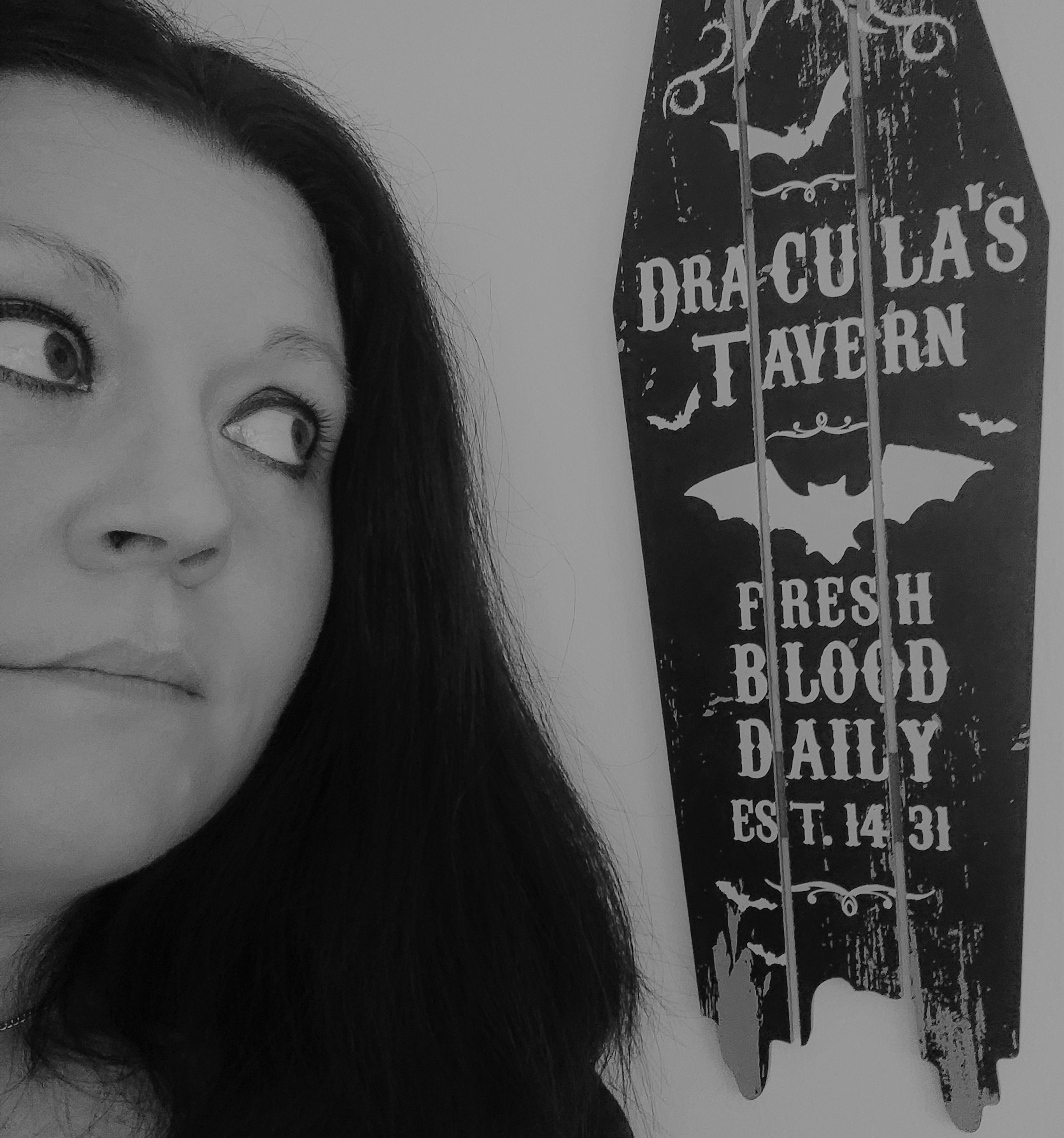
“Caroline Barnard-Smith is an award-winning speculative fiction author with too many ideas. She’s written horror, epic fantasy, and sci-fi, and she refuses to pick a favourite.” Source
I had a great time chatting with Caroline. We messaged back and forth to fit our talk around busy lives, even managing to send well wishes for what turned out to be a shared birthday! Connecting over motherhood and the pains of drafting, I started this interview typing one handed while an infant cuddled in my arms and now I’m writing it hiding from the sun in my backyard while that same infant snoozes next to me. Caroline and I talked about how she finds balance in her writing life and beyond. She seeks out the joy in her work. That was clear in our discussion and in her work. I hope you find it just as inspirational and encouraging as I did.
Reina Cruz (RC): Your winning story from Season 3, Riding the Viper, drops readers right into the middle of a vivid, dangerous world through gorgeous and visceral descriptions. Can you tell us about that story and what led you to submit it to the Lunar Awards?
Caroline Barnard-Smith (CB): I do love a good bit of visceral description. I heard about the Lunar Awards when I was still fairly new on Substack, and I thought it might be a fun way to connect with other writers and maybe get my name out there. I hadn’t actually posted any fiction before that. I was using Substack primarily as an author newsletter, and I was posting weekly about my writing routine and any stories I’d had published. Deciding to enter the Lunar Awards was eye-opening because it showed me how awesome the fiction side of Substack is, and made me think differently about what I was posting. It finally led to what I mostly do on Substack now, which is serialise novels.
I hadn’t finished writing Riding the Viper when I heard about the Lunar Awards; I just knew that I wanted to enter something (which was great because it pushed me to finish it before the deadline). I had recently become interested in classic sword & sorcery and was reading the original Conan stories and Tanith Lee’s fantasy novels. There’s been a bit of a sword & sorcery comeback in the last few years, and I was loving the modern take on the genre too. Basically, I wanted to write my own version of a sword & sorcery story. I’ve written more pieces since, and Riding the Viper has become part of a larger world, but sadly I haven’t yet managed to find a home for any of them. Maybe I should post some of my new stuff on Substack.
RC: The world of Riding the Viper already reads so expansive! More stories from that world would be fascinating.
Your response actually brings me to my next question about the serializing you are doing on your substack. You’re currently serializing The Obsidian Druid. What made you decide to serialize that particular book, and how has the experience of releasing it chapter by chapter shaped how you’re writing it?
CB: I’m going to make an admission here: I’m actually cheating with The Obsidian Druid because it’s been completed for a while. I indie-published it in 2024 and never considered a serialisation. Then my sci-fi series ended on Substack, and I decided to conduct a little experiment by posting The Obsidian Druid for free, alongside paid chapters of the sequel I’m currently writing. This was a bit of a head-scratcher to start with because I knew no one would pay to read the second book in an epic fantasy trilogy if they hadn’t read the first one. I got around this by offering ebook copies of The Obsidian Druid to readers who upgraded to paid. I don’t think it’s something I would repeat, but being able to play around and experiment is one of the reasons I’ve stayed on Substack.
Midnight Metropolis, a sci-fi horror story I serialised from 2024 to 2025, was a bona fide seat-of-your-pants affair. I had a loose plan I stuck to while writing, but serialising makes you highly susceptible to a good cliffhanger and the details often shifted. I started with the first few chapters already written, then fell behind and found myself feverishly writing and editing to kick that week’s chapter out the door. I miss doing that, actually. It’s a bit of a sick rush. When The Obsidian Druid concludes next year, I’m definitely going back to that approach. I think the next one might be a horror novel.
RC: Your about page describes you as an award-winning speculative fiction author with “too many ideas” who “refuses to pick a favourite” genre. What does writing across fantasy, horror, and sci-fi give you that staying in one genre wouldn’t?
CB: I have always loved reading across all three genres, so it felt natural to write across all three genres. Plus, sometimes I’m in a horror mood, and sometimes I’m in a fantasy mood. It’s nice to have the freedom to change tack when I want to. A lot of writing advice says that you should stick to one genre, or one niche, so you don’t put readers off. That’s probably good advice, but I’m terrible at sticking to it.
RC: Do you work on one project at once or do you jump between your works in progress?
Not jumping between projects would make my life simpler, but it wouldn’t be as fun. At the moment, I’m focused on finishing The Scarlet Warrior (the sequel to The Obsidian Druid), yet somehow I’ve also managed to plan and start writing a horror novella. I try to dedicate Monday through Thursday to the main project, then use Friday to work on whatever’s currently taking up space at the back of my brain. Like a horror novella about a reclusive vampire stuck in the 80s, or a short story about pregnant robots quietly taking over the English countryside. Sometimes life gets in the way, but this is my ideal week.
RC: Your side projects sound AMAZING! The description of your day to day in the week makes me wonder when you squeeze in the other aspects of publishing, marketing, ads, etc. Do you experiment with the other elements of the business like you do with your writing?
I have experimented, and the results prove that I suck at social media. I was active on Twitter before it turned ugly and morphed into X, but I never gained much traction. Bluesky feels like shouting into a crowded room; I was banned from Instagram and Threads for reasons that defy all understanding, and I hate Facebook with the intensity of a thousand suns. My daughter tells me I need to be on TikTok, but that seems like a full-time job of its own (plus I’m rubbish whenever a camera’s thrust in my face).
I’ve yet to try any serious advertising, although I keep meaning to look into it. What’s worked best for me so far has been my newsletter on Substack, so that’s where I’ve been concentrating my efforts. I’ve also been using BookFunnel for a while, and I’ve found that really useful. In the future, I want to put more time into Pinterest. I’ve heard encouraging things. As for squeezing it all in, I rely on a weekly planner and copious amounts of caffeine.
RC: Speaking of other aspects of the author business, your website is a love letter to the early internet era. I enjoyed clicking through your page. You really built something that feels handmade and special. What drew you to that aesthetic, and what does it say about how you think about your online presence?
CB: I aim for handmade and special, but sometimes I worry my site comes off as amateurish, so you’ve just made my day. I think I will always miss the early web. I built websites on Geocities (RIP) when I was a teenager, and I loved everything about the net back then. Scrolling text, crazy pixelated GIFs, guestbooks, webrings, all of it.
I stumbled across Neocities, the spiritual successor to Geocities, in 2020, and the instant nostalgia hit helped keep me sane while the world was busy imploding. I couldn’t believe people were still making retro-style websites and coding everything themselves (and some of them never stopped). Obviously, I had to make my own. I’d built author sites before, but they were based on boring templates or generic WordPress layouts. I never loved them, and eventually I’d let them all lapse. Just like the genre hopping, I disregarded all author advice about professional-looking sites, and decided to just have fun with it. My 90s-era HTML skills are a bit rusty, and I’m sure the site still looks wonky on smaller screens. I’m learning all the time, but it makes me happy, and I’m stubborn. I still need to get myself a guestbook, though.
Building this site actually helped me crystallise what I want my online presence to be: a nostalgic swamp witch with modern sensibilities. It bleeds into the retro-inspired horror novellas I’m writing, and the things I talk about in my newsletter, like my appreciation for 80s pulp horror covers and the vintage fantasy books I’m reading.
RC: You also have some great links and resources on your page. What resources, communities, or corners of the web have been most valuable to you as a writer?
There are a few places I keep an eye on when I’m looking for a home for a short story. Horror Tree and The Submission Grinder are both great resources, and Angelique Fawns regularly publishes an excellent newsletter listing open short story markets.
I often get stuck for character names, and my dirty little secret is that I’ll peruse Fantasy Name Generators for inspiration. I don’t borrow the name suggestions wholesale, but sometimes it will spark an idea for one of my own. I like this site because the list of categories is huge, it doesn’t use AI, and it donates money to Eden Reforestation Projects.
Sadly, a lot of the community places I used to visit have gone quiet or disappeared. I find Discord a bit overwhelming, so since Twitter went feral, the best community I’ve found is on Substack (another reason why I’m still here). There are so many people doing interesting things, looking to collaborate, or just writing incredible fiction. I’ve started seeing a lot of short story calls in the Notes feed, and there are entire lit mags and even small press publishers being born here.
One of those publishers is Sol Stories, and back in February, they were just a Note asking if anyone fancied contributing to an anthology about a near-future dystopian Britain. I responded, and now I’m being published in an anthology alongside twenty-two talented Substack writers.
RC: Future Britains Anthology, the anthology Caroline mentioned above was released October 23rd! Caroline mentioned you can read her “reproductive robots” story in the anthology (yes please!) You can get more details at
These resources are so helpful! I know Lunar Award writers will appreciate them!
Your retro brand is awesome. You seem to be focusing on the aspects of publishing that you truly enjoy. I’m sure that makes writing more sustainable. I know it does for me.
It definitely makes writing more sustainable. It can be hard to get noticed now, and even harder to persuade people to hand over hard‑earned money to read something you’ve written, but I’ll keep going as long as I enjoy it.
RC: What’s one thing you want the Lunar Awards community, speculative writers at all different stages of writing and publishing, to know either about writing or you?
I’ve had to think really hard about what I’d like other speculative writers to know. I’m not successful in the conventional sense. I’ve never been traditionally published or seen my books on the shelves of a major retailer, but I have been writing and publishing for twenty‑four years (I just did the maths and that number is scary!). My first novel was published by a small press founded by Storm Constantine. I’ve won awards and competitions. I’ve sold short stories I’m really proud of, and my newsletter seems to be growing at a slow yet steady rate. Success looks different to everyone.
I think I’d like to tell people that I don’t find writing easy. At all. I have to force myself to sit in my chair every day and start typing. Many authors say they love cranking out their first drafts. They rush to their keyboards like I’d rush to a bottle of wine on a Friday night. (Although I do enjoy editing once all the words are set down; maybe I’m a weirdo.) Stephen King said that when he’s writing, “it’s all the playground.” Californication hasn’t aged well, but I resonate more with Hank Moody, who compares it to “having homework for the rest of your life.” If there are other writers reading this who feel like me, I’d want them to know they’re not alone. But if you feel the same way I do when I’ve reached my day’s word quota—that singular satisfaction you only get when you’re doing the one thing you think you don’t suck at—then it’s all worth it.
Don’t forget to check out Future Britains Anthology to read Caroline’s latest work!
Caroline Barnard-Smith is an award-winning horror, science fiction, and fantasy writer from the UK. You can find the full range of her work and talent on her substack and her website.