

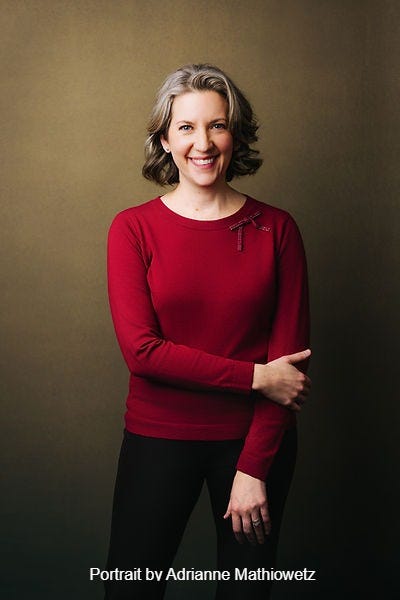
Meg Oolders was the first winner of the Lunar Awards back in April 2023 for her short story, “Sweet Sixteen”. She describes herself as an author, humorist, and podcaster. Not only has she won a Lunar Award, Meg has also been recognized by Writer’s Digest and Wattpad for her work. Her debut novel, See Dot Smile, is coming out February 9th. Meg Oolders also hosts other authors on her podcast, Talk Fiction. It was such a pleasure to pick Meg’s brain about her writing process, how she approaches genre and theme in her work, and all the wonderful additions she brings to the writing community as a whole.
We are so grateful that Meg returned to the Lunar Awards community to share her story and insights. I hope you find inspiration in her interview.
Reina Cruz (RC): “Sweet Sixteen” was the story that brought you into the Lunar Awards orbit. Can you tell us how you found the community and what made you want to submit that particular story?
Meg Oolders (MO): “Sweet Sixteen” has such a delightful origin story that has everything to do with finding my writing community on Substack. Shortly after I started publishing my newsletter, I discovered Fictionistas, a collaborative Substack for fiction writers founded by Jackie Dana and Geoffrey Golden. One of its earliest members was Brian Reindel, the founding father of The Lunar Awards. I quickly became embroiled in a fiction writing challenge with nine other writers (including Brian), which introduced me to the event’s organizer. J.E. Petersen. After the challenge, J.E. reached out to me about another collaboration. We brainstormed a bit and decided to do a story exchange, where we’d each write a piece of short fiction, hand it off to the other for them to rewrite it as they saw fit. “Sweet Sixteen” was the story I rewrote from J.E.’s original story. And it was Brian Reindel himself, having just launched the Lunar Awards, who nudged me to submit it to the first round. :-) “Sweet Sixteen” is also the story that later won honorable mention in the Writer’s Digest competition. It’s reached a lot of people and I’m quite proud of it.
RC: That is quite a journey that led to “Sweet Sixteen.” There are so many great communities to find on Substack, really exemplifying the writing community. You have a debut novel coming out this year. Congratulations! With a debut novel on the way, two major writing awards under your belt (Watty and Writer’s Digest), and a podcast, what does this season of your creative life feel like compared to earlier chapters?
MO: I love that you used the word “season”, because getting used to seasonal changes in my creative life has been essential for me, particularly in the last year with my novel finally getting picked up by a publisher. My current season is very much about showing up in new spaces, positioning my book for better visibility, growing my audience, and finding marketing strategies that I can stomach, because I really don’t care for the business side of being a writer. I miss hiding away in my basement writing books and look forward to wrapping up final edits on See Dot Smile (my Watty award-winning debut) so that I can reinvigorate my creative writing practice to make space for something new. Even if it’s just writing a chapter or two a week in the margins. As for the podcast, I’m determined to keep that alive. At this point, I’m only managing an episode a month, but the experience of talking with other authors about their writing life is so valuable to me. I’ve learned so much from my Talk Fiction guests over the past two years. And I know listeners value the unique perspectives of fellow creatives making their way in the world as much as I do.
RC: I think it’s so cool how your different pieces, “Sweet Sixteen” and See Dot Smile have gone through different “seasons” in a sense, with the awards all leading to your partnership with a publisher. What kind of marketing have you found enjoyable as you go through your first official book launch?
MO: I wish I could say I found some aspect of marketing “enjoyable.” :-) I am having a bit more fun on social media lately, Instagram specifically, though that enjoyment waxes and wanes. I think where I continue to struggle with the marketing piece is that I’m eternally searching for a way to promote my book that rests somewhere between what the entire marketing universe insists will work, and what I am actually comfortable with and really like doing. If you spend enough time on social media, you learn pretty quickly what types of marketing you DON’T like and therefore don’t want to create yourself. And when you do find something you like that another author is doing, the desire to make your version of that stand out and not just be a carbon copy becomes the next challenge. I am learning a lot as I go, I’ll say that much. And have encountered a lot of inspiring author accounts online, people I think are “doing it right.” Looking ahead, I’m most eager to market my book through podcast guest spots and other types of collaborations, both in person and online. I think those opportunities are extra valuable because in addition to having the floor to hype your book, you’re also forging a connection with another creator. And I don’t think you can ever have enough of those.
RC: Have you had the opportunity to share your book on a podcast yet? I’d love to share the episodes, now or in the future.
MO: I’ve been a frequent guest on Claudine Wolk’s podcast, Get Your Book Seen and Sold. She’s been a champion of my book from the beginning. Here’s a link to our most recent chat, wherein I talk a bit about my experience getting See Dot Smile picked up by Empress Editions!

RC: Speaking of podcasts, we’ve briefly discussed how you host your own. What has hosting Talk Fiction taught you about writing, community, and/or yourself that you didn’t expect?
MO: Talk Fiction has been such a source of pride and enjoyment for me because it plays to so many of my strengths, both as a writer and a personality. I do quite a bit of work on the front end, before I even sit down with a guest, to write them a stunning introduction highlighting their accomplishments. I don’t share this with them ahead of time, so I get to enjoy their reaction to hearing how amazing they are in real time. I was surprised to discover that I really enjoy the editing piece, though I probably shouldn’t be surprised. This definitely aligns with my perfectionist streak when it comes to presentation. I have my background in theater, music, culinary arts, and floral design to thank for that. I learn a lot about writing and creative entrepreneurship from hosting because I deliberately invite creators to join me who are doing something I’m not or something I’d like to get better at. So, it’s less a show about promoting books (though that’s a nice bonus) and more about learning how other artists practice craft, mindset, marketing and promotion, or any of the other hats we wear as “writers.” Lastly, I didn’t expect the podcast to last this long! I’ve been at it almost two and a half years already. Delivering episodes monthly, plus taking a couple of months off in the summer, has helped keep me from burning out. And it keeps me excited about finding guests who might bring something new to the table in future episodes.
RC: Shifting back to your two pieces, “Sweet Sixteen” is a sci-fi coming-of-age story, while See Dot Smile is a YA romance. Do those feel like two different genres to you, or two sides of the same one?
MO: Ooh. Fabulous question. I would say that both stories fit snugly into the coming-of-age category--teenage protagonists navigating adolescence-- with wildly different external circumstances. I think all young adult fiction relies heavily on interiority, what the characters are feeling while they navigate changes, challenges, and threats within their own bodies and worlds. This is why you’ll find a lot of YA stories written in first person point of view. It allows the reader to get under the character’s skin and experience what’s happening to them in real time. Both stories carry romance markers, too, because whether or not love is the goal, curiosity, desire, and heartbreak are ever-present (thank you, hormones) in the lives of those becoming adult humans. Another parallel would be the attention paid to family, both biological and found. Because young adults are still, in many ways, children who are reliant on and subject to the decisions made by the grownups in their lives. So ... considerably more similarities there than I even realized. Thanks so much for that question!
RC: The connections you made between your pieces are beautiful, the way you’ve broken down two supposedly different genres into how they overlap. It has me wondering about writing across different genres. That tends to be something writers are discouraged from doing. While your work crosses genres, the themes and heart behind your words align. Does that translate to your audience, or do you find that you have a YA romance audience, sci-fi audience, etc?
MO: Love this question. I’ve often worried about whether or not the audience I’ve built on Substack, writing short fiction and poetry, much of it very experimental, is likely to follow me on my YA novel writing journey. The fact that I’m able to draw threads between all of my fiction writing means I can probably (ideally, maybe) convince other people to embrace those commonalities, too. Some may require more convincing than others, of course. If I’m able to publish more YA books in the future, I think it’s possible I’ll have more sway with YA audiences. For now, I’m still a multitude with a very wonky body of work.
RC: Humor seems to be central to your voice. I see that in your podcast as well as on your website. How do you think about humor as a craft tool, especially in emotionally heavy stories?
MO: Yes, humor finds its way into almost everything I do. And yes, I am that person who makes jokes at funerals to lighten the mood. And I have to believe that is why I almost instinctively inject humor into my fictional stories. To keep my characters safe from emotional annihilation. For me, I worry it’s not so much a tool as it is a crutch! Humor is a natural tension diffuser, so it’s always tempting to use it when a scene gets really heavy, HOWEVER, tension is what builds anticipation and keeps readers engaged, so I often have to temper my funny girl instincts with what I’ve learned makes good fiction. That said, one thing I think all of my stories offer is some element of hope, even in dark times, and humor is often the vehicle I use to deliver that message.
RC: A big part of the Lunar Awards is building a community where writers feel seen, supported, and inspired to keep going. What has kept you going through the harder, quieter moments of your writing life?
MO: To be honest, I haven’t had a quiet moment in my writing life for a long time. The closest thing would be spending the last two weeks editing my novel. It required me to tune out almost everything else. And it felt AMAZING. If by quieter moments you mean stretches of time where not much happens with your writing, I’m starting to appreciate (and yearn for) those seasons more and more. Writing (thinking, dreaming, planning, problem solving, decision making, facing rejection) is an exhausting endeavor. Breaks are so necessary, in my opinion, for filling the creative well. Before I wrote all my novels, I was reading a ton of books and taking a lot of writing classes. I needed that input in order to create all that output. One thing that has kept me going, in recent months, is the realization that this whole journey is just one long game of chutes and ladders. The trips down are always a blow to your progress, but the climbs up build resilience. Every time I crawl out of the low of a rejection, a bout of self doubt, or a hard-learned business lesson, I remember all the times I’ve been down before. And that I was able to get back up every time. Also, I think the ups are cumulative. Every win comes with a badge, real or symbolic, that you can wear proudly moving forward. Some of them ... like a Lunar Award win ... might create a surprise opportunity down the line ... like this delightful interview!
RC: What’s one thing you want the Lunar Awards community, speculative writers at all different stages of writing and publishing, to know either about writing or you?
MO: My advice to fellow creatives: To the best of your ability, try not to compare your work, your journey, or your credentials to anyone else’s. No matter how much you may want to follow in another writer’s footsteps, there are WAY too many variables at play for that to ever happen. On the plus side, YOUR work and YOUR journey can never be replicated either. Own your story. And remember, you have the power to change it any time you want! Easier said than done, I know. But that’s the stuff I’d tell myself if I was asked this question, which I was ... so there you go.
So many thanks to Meg for taking the time to answer my questions for the Lunar Awards community. You can stay up to date on Meg’s debut novel and her other writing endeavors at her website and through her substack:
Great interview, Reina and Meg. It's so nice to get to know Meg better and be inspired by the work you're doing. I'll have to check out the podcast ASAP! And the advice to not compare oneself to another is spot on. It's too easy to get caught in that spiral, and it's avoidable. If we are content with the day's work, we've succeeded. Thanks for taking the time to share your story and thoughts with us. Wishing you the best of luck on your publishing and writing journey!
Great interview!